AlgebraTilesWorking withAlgebraTiles
Created by MathBits.com

All Rights Reserved © MathBits.com
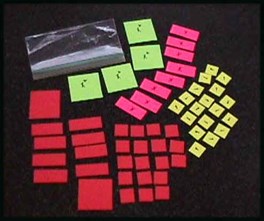
Tiles can be easily (and cheaply) producedusing colored card stock or 3x5 cards.While positive tiles can all be one color, ora variety of colors, negative tiles should bered.  Package the tile sets in sandwichbags and create enough sets so that eachstudent in the class has his/her own set.
An "enlarged" tile set with magnets on theback can be prepared for demonstrationsat the blackboard.  Magnetic strips can befound in any craft department.
This is my class set of tiles which contains:positive tiles                negative tiles
18 unit tiles (yellow)      18 unit tiles8 "x" tiles (pink)             8 "x" tiles4 "x²" tiles (green)         2 "x²" tiles (all red)
Many of the commercial versions of algebra tiles are made from plastic andpossess a "projectile" quality.  These homemade tiles are seldom "airborne"since they are aerodynamically deficient. ;-)

Make Your Own TilesMake Your Own Tiles
Return to MathBits.com
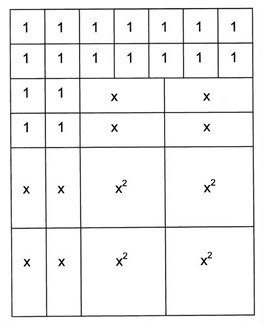
Template for homemade tiles:Template for homemade tiles:
     If your copy machine canprocess card stock paper,you can transfer thetemplate directly to the cardstock.  If not, you may needto measure and cut the tilesby hand.
Return to MathBits.com
Algebra Tile PiecesAlgebra Tile Pieces
From the previous template, you can see the relationshipbetween the sizes of the tiles.
x
x2
1
The x2 tile is a square whosesides measure x by x.
The x tile is a rectangle whose sidesmeasure x by 1.  Notice that it isNOT possible to arrange the 1 tilesto create an x tile.
The red pieces are additive inverses for their counterparts.When used together, a “zero pair” is created (they cancel each other out).
     +       =  0
+1             -1
Return to MathBits.com
Remember Remember 
When a tile is paired together with a matching sizered tile, a zero pair situation is created and thepieces can be removed.
Return to MathBits.com
Let’s StartUsing OurTiles!Let’s StartUsing OurTiles!
Return to MathBits.com
FactorsFactors
Using Algebra Tileswith . . .
Return to MathBits.com
Factors of Integers:Factors of Integers:
6 x 1
1 x 6
2 x 3
3 x 2
Example 2:Represent the number 3.Arrange the pieces to form asmany rectangles as possible.
Example 1:Represent the number 6.Arrange the pieces to form as manyrectangles as possible.
3 x 1
  1 x 3
An example of the factorsof prime numbers.
Return to MathBits.com

Addition ofSignedNumbersAddition ofSignedNumbers
Using Algebra Tileswith . . .
Return to MathBits.com
   (+2) + (+3) =
Signed Numbers:  Integer AdditionSigned Numbers:  Integer Addition
+
= +5
Adding positive integers yields another positive integer.
= -3
+
Adding negative integers yields another negative integer.
(-1) + (-2) =
Return to MathBits.com
(+4) + (-3) =
(-3) + (+1) =
(-2) + (+2) =
Signed Numbers:  Integer AdditionSigned Numbers:  Integer Addition
+
= +1
+
= -2
+
= 0
Rule:  If the signs are different, subtract the “numerals” and take the sign of the larger“numeral”.
Return to MathBits.com
Subtractionof SignedNumbersSubtractionof SignedNumbers
Using Algebra Tileswith . . .
Return to MathBits.com
(+4) – (+1) =
(-3) – (-2) =
Signed Numbers:  Integer SubtractionSigned Numbers:  Integer Subtraction
Subtraction Rule:  Change the sign of the number being subtracted andfollow the rules for addition.  “Adding the opposite”.
-
+
= +3
-
+
= -1
Return to MathBits.com
(+3) – (-2) =
(-4) – (+3) =
(-2) – (+2) =
Signed Numbers:  Integer SubtractionSigned Numbers:  Integer Subtraction
Subtraction Rule:  Change the sign of the number being subtracted and followthe rules for addition.  “Adding the opposite”.
-
+
= +5
-
+
= -7
-
+
= -4
Return to MathBits.com

Multiplicationof SignedNumbersMultiplicationof SignedNumbers
Using Algebra Tileswith . . .
Return to MathBits.com
(+3)•(+4) =
(+2)•(-3) =
Signed Numbers:  Integer MultiplicationSigned Numbers:  Integer Multiplication
We will be using the concept that the “multiplier” will be “counting” for us thenumber of sets we need.  If the “multiplier” is positive, we know the number ofrows to draw and we will be done.
= 12
= -6
3 rows ofpositive 4’s
2 rows ofnegative 3’s
Return to MathBits.com
(-3)•(+4) =
(-2)•(-3) =
Signed Numbers:  Integer MultiplicationSigned Numbers:  Integer Multiplication
If the “multiplier” is negative, after drawing the number of rows, we will have to“take the opposite of” (flip) the answer.
= -12
= 6
3 rows of positive4’s flipped
2 rows of negative3’s flipped
Return to MathBits.com
Division ofSignedNumbersDivision ofSignedNumbers
Using Algebra Tileswith . . .
Return to MathBits.com
Signed Numbers:  Integer DivisionSigned Numbers:  Integer Division
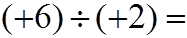
We will again be using the concept of  “counting”.  The “divisor” will tell us thenumber of rows to draw.  If the divisor is positive, draw the rows and you aredone.
= +3
= -2
Divide into 2 rows
Divide into 4 rows
Return to MathBits.com
(+4)/(-2) =
(-6)/(-3) =
Signed Numbers:  Integer DivisionSigned Numbers:  Integer Division
If the divisor is negative, draw the rows and take the opposite of the result.
= -2
= +2
Divide into 2 rowsand flip
Divide into 3 rowsand flip
Return to MathBits.com
SimpleSubstitutionSimpleSubstitution
Return to MathBits.com
SubstitutionSubstitution
   Find  2x + 3  if  x = 2
 
Replace eachx tile with twounit tiles.
Answer:  7
Return to MathBits.com
SubstitutionSubstitution
   Find  3x - 4  if  x = -3
 
Replace eachx tile withthree negativeunit tiles.
Answer:  -13
SolvingEquationsSolvingEquations
Return to MathBits.com
Solving EquationsSolving Equations
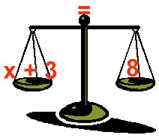
   x + 3 = 8
Remember to balance the equation.  What you do to one side ofthe equal sign, you must do the same to the other side.
Solve for x, by isolating the x.  Get the x alone on one side of the equal sign.
x = 5
Return to MathBits.com
Solving EquationsSolving Equations
2x + 2 = x – 6
3x – 1 = 5
x = 2
x = -8
Return to MathBits.com
TheDistributivePropertyTheDistributiveProperty
Return to MathBits.com
Distributive PropertyDistributive Property
   3(x + 2) = 3x + 6
Return to MathBits.com
WorkingwithPolynomialsWorkingwithPolynomials
Return to MathBits.com
RepresentingPolynomialsRepresentingPolynomials
Using Algebra Tileswith . . .
Return to MathBits.com
Representing PolynomialsRepresenting Polynomials
3x2
 
2x+ 3
Return to MathBits.com
AddingPolynomialsAddingPolynomials
Using Algebra Tileswith . . .
Return to MathBits.com
Adding PolynomialsAdding Polynomials
   Add: 3x +1 and x +3
+
 = 4x + 4
Add:  (-2x + 3) + (x + 1)
+
= -x + 4
Return to MathBits.com
Adding PolynomialsAdding Polynomials
   Add: (2x2 + 2x + 3) + (x2 – x – 2)
+
 = 3x2 + x + 1
Return to MathBits.com
SubtractingPolynomialsSubtractingPolynomials
Using Algebra Tileswith . . .
Return to MathBits.com
Subtracting PolynomialsSubtracting Polynomials
   3x + 2  subtract  x - 4
+
 = 2x + 6
Add theopposite!
-
Return to MathBits.com
Subtracting PolynomialsSubtracting Polynomials
   (2x2 – 3x – 1) – (-x2 – 2x – 3)
Add theopposite!
-
+
= 3x- x + 2
Return to MathBits.com
MultiplyingPolynomialsMultiplyingPolynomials
Using Algebra Tileswith . . .
Return to MathBits.com
Multiplying PolynomialsMultiplying Polynomials
(x + 1)(x + 2)
Answer will be thesum of theelements within thegrid.
Fill in the internal grid withtiles.  Be sure that straightlines are maintained withinthe grid at all times.
x+ 3x + 2
Return to MathBits.com
Multiplying PolynomialsMultiplying Polynomials
   (x - 2)(x + 3)
Answer inthe grid
x+ x - 6
Remember that a negativevalue times a positivevalue gives a negativeresult.
Return to MathBits.com
Multiplying PolynomialsMultiplying Polynomials
   (x - 2)(x - 1)
Answer inthe grid
x- 3x + 2
Remember that a negativevalue times a negativevalue gives a positiveresult.
Return to MathBits.com
DividingPolynomialsDividingPolynomials
Using Algebra Tileswith . . .
Return to MathBits.com
Dividing PolynomialsDividing Polynomials
   x2 + 5x +4
       x + 1
Place the numerator inside the grid.Place the denominator on one of the outer edges.
Answer
x + 4
Return to MathBits.com
FactoringPolynomialsFactoringPolynomials
Using Algebra Tileswith . . .
Return to MathBits.com
Factoring PolynomialsFactoring Polynomials
   2x + 6
When factoring, place the problem inside the grid.  Theanswers will be the found on the outer edges,maintaining straight lines within the grid.
The factors arefound on theouter edges.
2(x + 3)
Return to MathBits.com
Factoring PolynomialsFactoring Polynomials
   3x - 9
Is there more than one correct answer?  Let’s take a look.
3(x - 3)
-3(-x + 3)
Return to MathBits.com
Factoring PolynomialsFactoring Polynomials
   x2 + 5x + 6
Remember that a pattern must be found inside the gridsuch that straight lines between tiles is maintained.
(x + 2)(x + 3)
Return to MathBits.com
Factoring PolynomialsFactoring Polynomials
   x2 - 6x + 8
(x – 2)(x – 4)
Return to MathBits.com
Factoring PolynomialsFactoring Polynomials
   x2 + x – 6
Now what?
We needto  fill inwith zeros.
(x + 3)(x – 2)
Return to MathBits.com
Investigationsof PolynomialsInvestigationsof Polynomials
Using Algebra Tileswith . . .
Return to MathBits.com
Using Algebra Tiles forInvestigations.Using Algebra Tiles forInvestigations.
        Use Algebra Tiles to show that (x + 1)2 and (x2 + 1) are not equivalent.
x+2x +1
x2 + 1
Return to MathBits.com
Using Algebra Tiles forCompleting the SquareUsing Algebra Tiles forCompleting the Square
Algebra tiles can be used to visualize how a perfect
square trinomial can be formed.  The tiles can be used
by students (or used by the teacher) as a warm-up to
this concept.

?
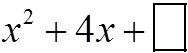
What is needed to create aperfect square trinomial for: 
Use the algebra tiles to create asquare.  What tiles will be neededto complete the square?
4
Help students see a pattern!
Return to MathBits.com
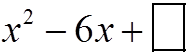
Completing the Square Completing the Square 
?
9
Notice thenegative tiles.
This example shouldhelp to solidify theconcept that the neededconstant term will be apositive value. 
Return to MathBits.com
Algebra Tileslet you “feel”mathematics.Algebra Tileslet you “feel”mathematics.

Return to MathBits.com