|
Sequences and Series
We are going to look at a series of questions related to sequences.
Various methods of solution will be shown.
 You need to use u(n) instead of an You need to use u(n) instead of an
for entering sequence notations on the calculator
as there will be no subscripts, and "u" is used.
|
Using the seq() command
Example 1: Explicit Sequence:
a) State the first 5 terms of the arithmetic sequence
an = 3n + 2
b) Find the sum of these first 50 terms.
Use the seq() command:
Start on a Calculator page.
 ; #6 Statistics;
#4 List Operations; ; #6 Statistics;
#4 List Operations;
#5 Sequences
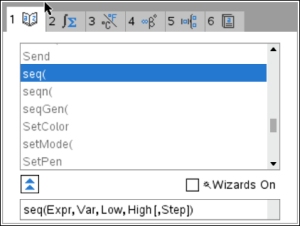
( or use the Catalog  to get the page below) to get the page below)
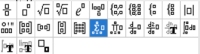
Use  to find the summation symbol (sigma): to find the summation symbol (sigma):
|
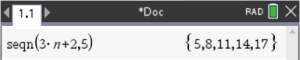
a)
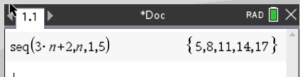
The pattern for entering this sequence is:
seq(expression, variable, first term number, last term number)
If you forget this pattern, it is listed at the bottom of the catalog page when seq( is highlighted (see catalog page on the left).
Note: There is a short-cut version called seqn() for where the variable is assumed
to be n.
b)
Using
template key choose the summation notation (sigma) from the template.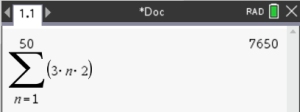 |
More Options:
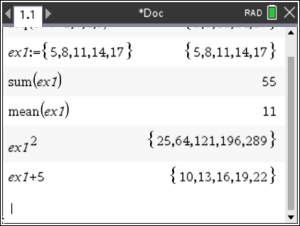
There is a symbol, :=, above the template key that allows you to define or assign an item. It stores the item under a designated name for future use.
Let's name our sequence ex1 (for "example 1"), and save it for future use:
ex1 := {5,8,11,14,17}
(or
ex1 := 3n + 2)
Now, we can perform operations on our saved sequence without having to rewrite the entire sequence each time.
(The "define" command in the catalog does this same thing.) |
|
Example 2: Recursive Sequence:
State the first 5 terms of the sequence
a1 = 1 and an = an - 1 + 2
Remember that we need to rename this sequence when entering into the calculator:
u(1) = 1 and u(n) = u(n - 1)+ 2
Use the seqGen() command:
Start on a Calculator page.
Open the Catalog and access seqGen(). |
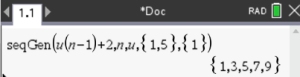
The pattern for entering this sequence is:
seqGen(Exp,Var,DepVar,{Var0,VarMax},{init})
Note: There is a short-cut version called seqn() where the variable is assumed to be n.

|
Using Function Graphs
(good for both arithmetic and geometric recursive sequences)
Example 3:
If a1 = 8 and an = 4 + 3 • (an - 1), find a2.
Start with Doc (graph) or Scratchpad (graph).
, #3 Graph Entry/Edit, #7 Sequence,
#1 Sequence
You will see the graphing set up for a sequence.
There are no subscripts, so just follow the pattern set by the calculator.
The calculator set up of u1(n) will be the name of our sequence, instead of an.
The a is now called u1. Replace a with u1 when you enter the sequence.
The previous term will be u1(n - 1).
The initial term is the starting term of the sequence. |
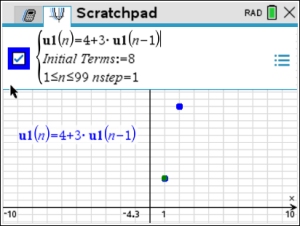 ` `
This is an easy problem that could be done just by substituting. a1 = 8. a2 =
4 + 3(8) = 28.
But if we wanted the 22nd term,
this method would be most helpful |
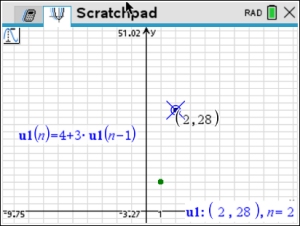
Use , #5 Trace, #` Graph Trace to see the ordered pairs associated with the sequence values. |
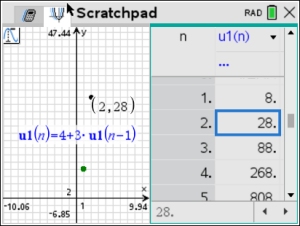
Or you can go to , #7, #1 to get a split table to see the values of the sequence. |
Using List and Spreadsheets
Example 4:
a) List the first 10 terms of the explicit sequence
an = 3n + 2
b) List the first 10 terms of the recursive sequence
a1 = 3 and an = 4 • an - 1
• Start with Doc (Add Lists and Spreadsheets)
• Use touchpad to move up to gray area next to =.
, #3 Data, #1 Generate Sequence
• Enter information: sequence formula, initial starting term, and nMax (the number of terms you want to see). OK
a) Listing of terms
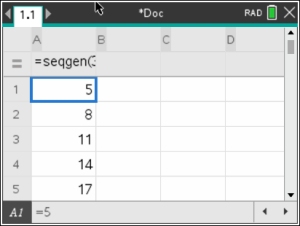
b) Listing of terms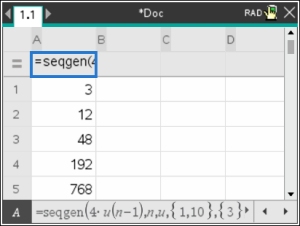 |
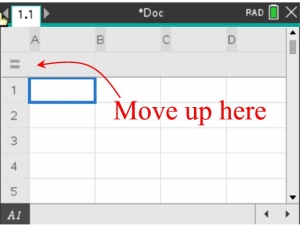
a)
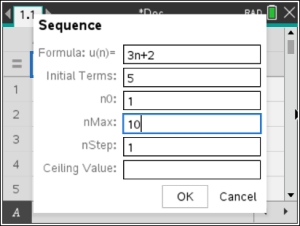 ` `
b)
remember to use u(n - 1)
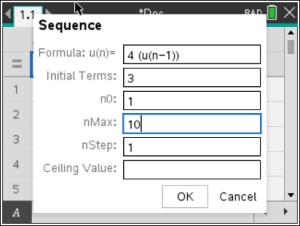
This method is particularly useful
for recursive formulas. |
Using Simultaneous Equations
(when working with sequences)
Example 5:
The 10th term of an arithmetic sequence is 137 and the 18th term is 257.
Find an expression for the sequence.
To find the expression, we will need to know the first term and the common difference.
an = a1 + d(n - 1)
a10= a + d(10- 1) = 137
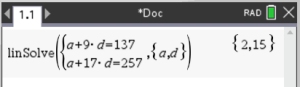
Enter: a + 9d = 137
a18 = a + d(18- 1) = 257
Enter: a + 17d = 257
The a = 2 (the first term)
The d = 15 (the common difference)
Expression: an = 2 + 15(n - 1)
an= 2 + 15n - 15
an= 15n - 13 |
, #3 Algebra, #2 Solve System of Linear Equations
Variable will be a and d.
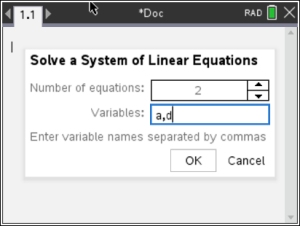
|
Solve Equations to Determine Info
Example 6:
a) Given the geometric sequence, an = 2 (4n - 1),
find the term number whose value is 32768.
Use the nSolve command. Set the sequence equal to the value needed, and ask the command to solve for "n".
b) Given a geometric series with a first term of 4 and a common ratio of 3, how many terms must be added to arrive at a sum of 13120?
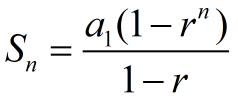
Use the nSolve command. Set the formula for the sum of a geometric sequence equal to 13120 and ask the command to solve for "n".
|
a) , #3 Algebra, #1 Numerical Solve
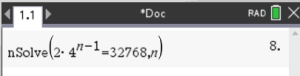
The 8th term is 32768.
b) , #3 Algebra, #1 Numerical Solve
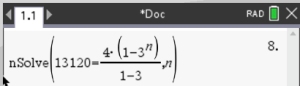
In takes 8 terms to get a sum of 13120, |
|